Should Franchises Have Separate URLs for Local SEO (2025)?
TL;DR
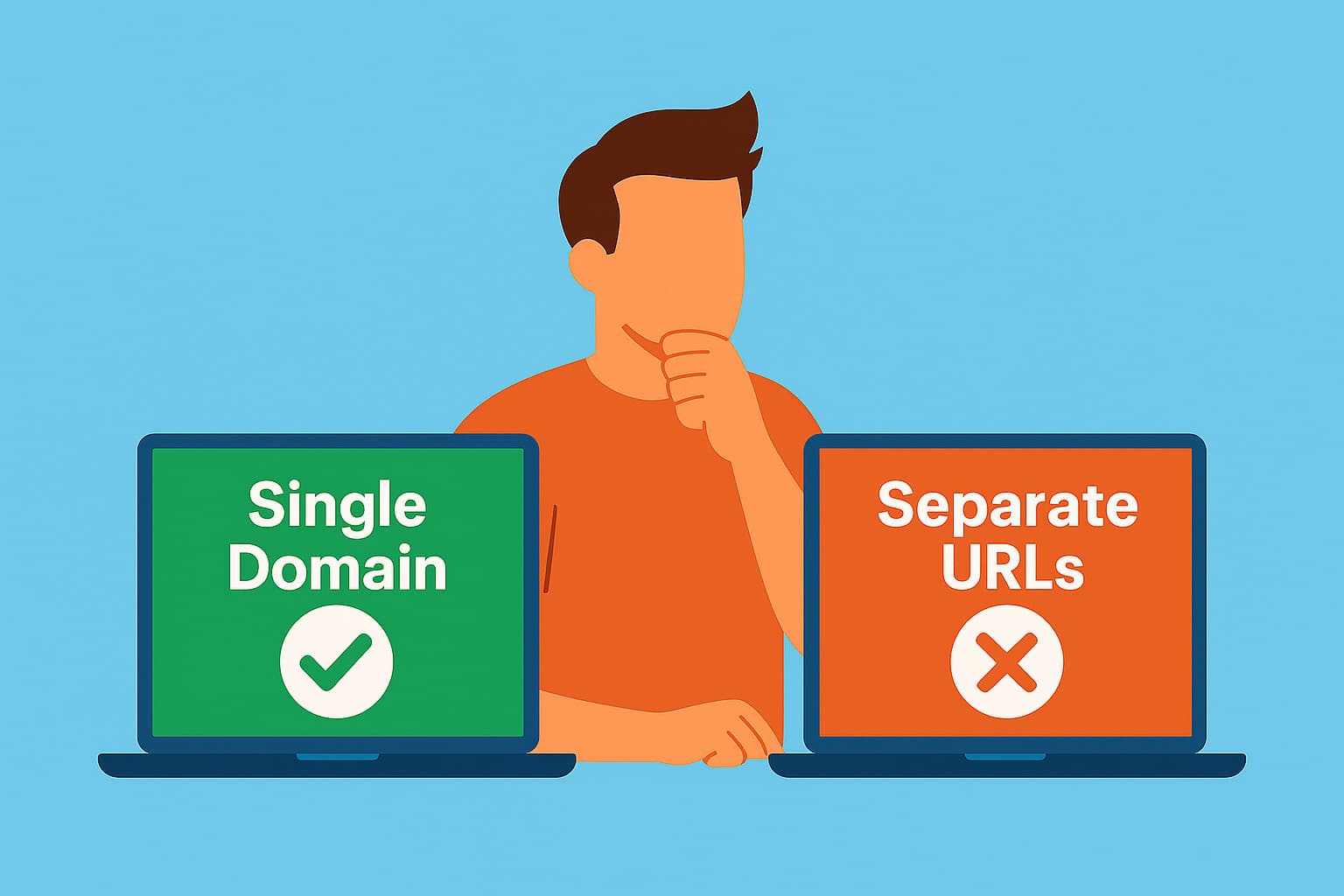
Should franchises have separate URLs for each location. Simply put, no.
The strongest SEO strategy is one main website with subdirectories for every franchise, backed by Google Business Profiles and unique local content.
This approach builds domain authority, keeps branding consistent, and helps each location rank higher in local search results.
If you run a franchise or a multi-location business, you’ve probably asked this a hundred times: should franchises have separate urls for local SEO (individual websites), or should everything live under one main website?
I’ve audited a lot of franchise SEO setups, and I’ve also researched how the biggest brands structure their web presence, partly for clients, partly because I’m a nerd about this stuff.
The pattern I keep seeing from the winners: one strong main site (single domain) with location pages in subdirectories.
Not five different websites. Not a patchwork of different domains. One site. Clear URL structure. Clean user experience.
I’ve seen what happens when every franchise location spins up an “own separate website.” It looks like freedom at first.
Then the headaches start: duplicate content, broken brand consistency, link building spread too thin, confusing navigation when the same customer visits two locations a week apart.
From a search engine optimization (SEO) perspective and from a customer’s point of view, a single website with great location pages is the better long-term marketing strategy.
What Local SEO Means for Franchises (and Why URL Structure Matters)
Local SEO is simple at its core: help potential customers in a specific geographic area find the right location. Search engines (and yes, those “creepy crawler” bots we joke about) want clarity.
They want to know which web page belongs to which franchise location, what the phone number is, where the business hours live, and whether you serve that specific area.
For franchises, that clarity starts with the main site and the URL structure:
Subdirectory model (recommended): yourbrand.com/kansas-city/
Subdomain model: kansas-city.yourbrand.com
Separate domains (different sites): yourbrand-kansas-city.com
The benefits of subdirectories:
-
Keep all authority under the main domain
-
Simplify internal linking (location selector, franchise locator pages, store locator results)
-
Make it easy for Google Maps and Google Business Profile (GBP) to pair each location page with the right listing.

Why Franchises Need One Website for Local SEO
I’ve watched franchises pour budget into a slick corporate franchise website and then miss the basics that move the needle in local search results.
Here’s where the gains come from when you get your local SEO efforts right:
Higher local search rankings. Clean city pages rank for “[service] + [city]” terms. That’s where local customers actually search.
Better user experience. Same design across individual locations = fewer drop-offs, more calls, more foot traffic.
Brand consistency. One consistent brand identity across every location page keeps trust high for business owners, franchisees, and customers.
Easier link building. Build quality links to one main website instead of watering them down across different domains.
Smarter review + GBP management. One site, many GBPs. Each listing links straight to its matching landing page.
Cleaner analytics. One property in Google Analytics/Google Search Console. Track user interaction, conversions, calls, and new clients without stitching data from different websites.
A lot of multi-location businesses feel pressure to launch a “new site” for every city because it feels like an easy way to localize.
In practice, it creates duplicate content, fractured brand visibility, and more maintenance than anyone wants to admit.
Separate URLs for Franchise Locations: Pros and Cons
I get why separate URLs sound appealing. I’ve seen franchisees push for their “own website” so they can run promotions, post blogs, or push new products in their specific location.
Sometimes, different legal entities under one parent company argue they need different domains just to feel independent.
But here’s what actually happens when you go down that road: the maintenance load multiplies, duplicate content creeps in, branding breaks apart, and the SEO value you’ve built gets sliced into pieces.
Where Separate URLs Look Attractive What Actually Happens (What I’ve Seen)
Franchisee wants control over their own site for promotions, blog posts, or new products Maintenance multiplies. Design tweaks, copy updates, schema, and fixes have to be repeated across a dozen sites
Different legal entities under one parent company think they need different domains Duplicate content risk. Same home page copy, same service descriptions, search engines don’t reward it
Feels like more local ownership Brand breaks. Different people update different sites, and the franchise brand starts drifting
Each site can collect its own backlinks Link equity splits. That great PR hit or local news mention only benefits one site, not the whole network
Bottom line: separate websites create more problems than they solve for most franchises. You’re far better off with one strong main domain quietly powering consistent, high-quality local websites (location pages) for every franchise.
When Separate URLs Actually Make Sense
I won’t say “never.” There are special cases:
Totally different concepts under one parent (e.g., a home services brand and a retail brand). Different target audience, different offerings, different positioning, separate domains can be a good idea.
Legacy systems you can’t unwind (for now). If you must keep different sites, set a plan to migrate to a single website over time.
Regulatory reasons in certain industries. Rare, but it happens.
If that’s not you, stick to a single domain with subdirectories.
Best Practices for Franchise SEO on a Single Website
These are the best practices I recommend (and build) again and again because they just work.
1) URL Structure & Information Architecture
Keep it readable and consistent: /city/ or /state/city/.
Use a franchise locator with filters for geographic area and services.
Link from the locator to each location page with descriptive anchor text (not just “Learn more”).
2) Location Pages That Actually Deserve To Rank
Include local information (landmarks, service area neighborhoods).
Prominent phone number, address, hours, parking, directions (better user experience = more conversions).
Embed Google Maps.
Add review sites badges (Google reviews, Yelp, industry-specific) and pull a few recent reviews to the page.
Post blog posts and social media embeds where it makes sense.
Use location-specific FAQs to capture local search results and “People Also Ask” intent.
Add location-level schema markup (LocalBusiness, openingHours, sameAs links).
3) Google Business Profile (Google My Business)
Create/claim a GBP for every location.
Link each GBP to its specific location page (not the home page).
Keep categories, services, and photos updated.
Encourage reviews and respond fast.
4) Content + Link Building For Local Authority
Publish high quality content about local needs, local news, and new products where relevant.
Sponsor local events; get local citations and quality links from chambers, charities, schools, and partners.
Use PR to earn links to the main site; the lift spreads across all location pages.
5) Mobile Devices, Speed, and UX
Inventory or menu pages must load fast on mobile devices.
Use clear CTAs: call, directions, book, order, schedule, don’t hide them.
Keep web page templates consistent so customers never feel lost bouncing between individual locations.
How the Right URL Structure Improves User Experience
Let me give you a real-life scenario I’ve seen. A franchise group had five franchisee websites within 15 miles. Same brand, five different websites.
A customer visited Location A one week, Location B the next. New layout. New nav. Couldn’t find the phone number. Bounce. That’s lost foot traffic and a bad taste.
Now picture a single website. One home page. A clean “Locations” selector.
Every location page shares the same layout, but the content reflects the specific location: local promos, team photos, area-specific services. Customers move between pages without re-learning the site.
User interaction goes up. Calls go up. Reviews go up. Rankings follow.
This is exactly how the big players operate. Chick-fil-A, for example: one corporate franchise website, location pages in subdirectories, and enough local control to show operator-level updates without breaking the brand.
Subdirectories vs Subdomains vs Separate Domains
Subdirectories (/city/)
Best for consolidating authority under the main domain
Easiest for internal linking and franchise locator UX
Cleanest analytics and governance
Subdomains (city.brand.com)
Can work, but often treated a bit more like different sites
Fragmented analytics and sometimes fragmented authority
Separate domains (brand-city.com)
Highest maintenance, highest risk of duplicate content
Hardest for link building and brand control
Rarely the right move from an SEO perspective
If you’re starting a new website, choose subdirectories. If you’re stuck with subdomains, you can succeed, but put a migration to subdirectories on your roadmap. If you’re on different domains, set a plan to consolidate.
Website Management for Franchises: Templates, Tools, and Local SEO
This is where website builders and CMS choices matter for multi-location websites. What I recommend:
Global templates enforce brand consistency while still allowing own content at the location level (menus, promos, staff).
A simple content governance doc: what’s global vs. what’s local, who approves what, how often you refresh content.
A central team that owns technical SEO, schema, performance, and search engine hygiene. Local teams add the context: photos, local copy, events, social media.
A quarterly checklist for local franchisee pages: hours, photos, offers, local citations, and GBP hygiene.
A marketing strategy that combines on-site content + GBP + review sites + link building. That’s your competitive advantage.
Franchise URL Decision Checklist
Question Best Approach
Do your locations sell to the same target audience with the same franchise brand? Single domain
Do you need site-wide brand consistency across multi-location businesses? Single domain
Do you want quality links to lift every location? Single domain
Do you have many individual franchisees who want control? Use subdirectories with flexible, governed components (not separate domains)
Are you diversifying into unrelated brands with different positioning? Consider separate domains
Are you tempted to launch a new site because it feels like a “great way” to localize fast? Resist. Build a strong location page instead
Bottom line: if the offering is the same across different locations, don’t split your authority across different URLs. Keep it on one main site, structure it well, and let each landing page do its job for its local area.

The Single-Domain Model Wins For Franchises in Local SEO
So, should franchises have separate URLs for each location? 99% of the time, no.
From what I’ve seen: in audits, in the wild, and in our own work: one strong website with subdirectories is the clearest path to stronger local search rankings, better online presence, and a smoother experience for real people.
It’s easier to manage, easier to scale, and easier to measure.
It also respects what search engines want: a clear structure, authoritative main domain, and pages that match the search intent in each local market.
If you need proof, look at how the leaders operate. The parent company keeps the corporate franchise website tight and fast; the location pages carry the local details; Google Business Profile listings point to the right pages; and digital marketing (content, social media, PR) drives quality links back to the main site.
If you’re on separate domains today, you can move. If you’ve got subdomains, you can consolidate. If you’re spinning up a new website, start with the right URL structure and skip the pain.
I want you to win here, not wrestle a web sprawl that drains budget and hides your best locations from potential customers.
If you want a second set of eyes on your setup, I’m happy to look.
I’ll tell you straight what to keep, what to fix, and the easy way to get from “five different websites” to one powerful business website that pulls in new clients across every city you serve.
Schedule Your Free Strategy Call
Frequently Asked Questions About Separate URLs for Franchises
Why is Local SEO important for franchises?
Local SEO ensures every franchise location is visible to potential customers searching in their specific area. It boosts local search rankings, drives foot traffic, and builds trust with consistent branding and positive reviews.
What are the challenges of maintaining separate URLs for franchises?
Separate URLs create extra work, from higher maintenance and duplicate content risks to branding inconsistencies. They also split link equity, making it harder for franchise locations to rank as strongly as they could under one main website.
Is it necessary for each franchise location to have its own Google Business Profile?
Yes. Each franchise location should claim and optimize its own Google Business Profile. This helps that location appear in Google Maps and “near me” searches, and allows reviews and contact details to connect directly to the right page.
Should franchises use subdirectories, subdomains, or separate domains?
From an SEO perspective, subdirectories (example.com/city-name) are the best choice. They consolidate authority, simplify management, and make it easier for search engines to connect each franchise location with its local market.
How can franchises avoid duplicate content across multiple locations?
Each location page should include unique details: address, hours, services, promotions, staff info, and local keywords. Adding location-specific content signals to search engines and improves user experience without creating thin or duplicate pages.
What’s the best URL structure for multi-location businesses?
The best practice is one main domain with subdirectories for each location (brand.com/city/). This structure strengthens the overall domain authority, improves rankings for every franchise location, and keeps the brand consistent across all markets.

Ready to grow your business online?
Griffin Mott Consulting helps local businesses in Kansas City rank higher, convert more, and grow faster.
Start a Conversation